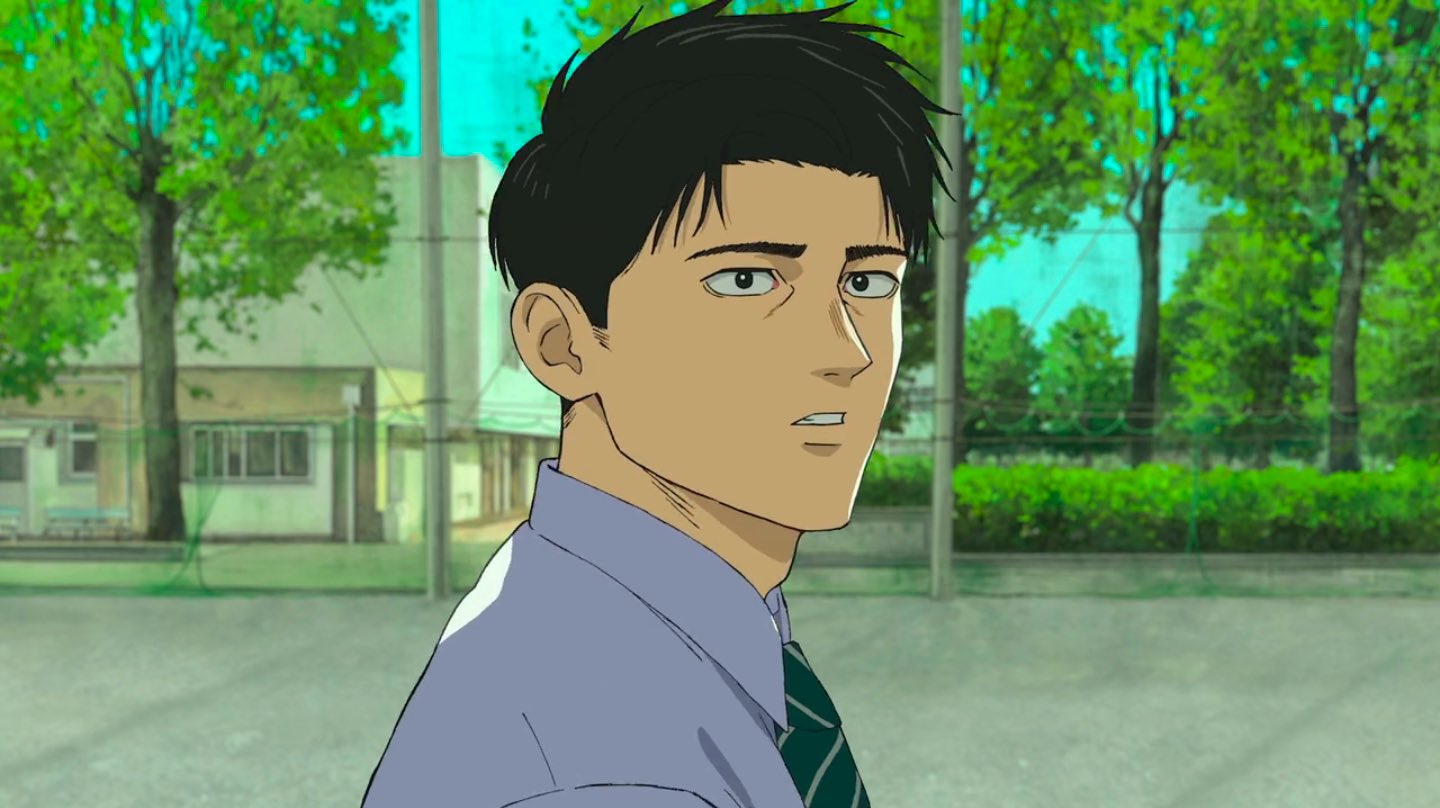
100 Meters is the latest anime film from studio Madhouse. I’ve been anticipating this release since its announcement, particularly given that it shares producers with Orb, one of my favourite anime.
At its core, 100 Meters is a deceptively simple premise: an anime about the 100-meter sprint. The film opens with protagonist Togashi in elementary school, already dominating his year in the sprint. His encounter with Komiya, a struggling runner who confesses to “running away” from reality, establishes the central tension that will define their intertwined journeys.
From this initial encounter, the film commits to an almost relentless interrogation of passion, purpose, and self-abandonment. What does it mean to lose yourself completely in something? How do we find meaning in our pursuits? The dialogue rarely relents from these existential questions.
The narrative structure follows Togashi and Komiya through three distinct periods—elementary school, junior high, and adulthood—with each stage introducing characters who challenge and refine their understanding of what running means to them. This chronological framework allows the film to examine how passion evolves (or dissolves) across a lifetime.
These interrogations form the foundation of 100 Meters’ exploration of ikigai and existential purpose. The film poses difficult questions: How much would you sacrifice for what you love? Can you maintain passion when you’re no longer exceptional? Would you continue if the meaning you once found evaporates?
While these philosophical exchanges between characters can occasionally feel overly direct, even didactic, the film’s New Year’s release timing speaks to its deliberate positioning as a meditation on commitment and reinvention—themes that resonate particularly during a season of resolutions.
However, 100 Meters has garnered its most fervent praise for its extraordinary use of rotoscoping. Though I am no expert in animation technique, the scale and execution here exceeds anything I’ve previously encountered in anime. The fluidity achieved in the sprint sequences, from the overall movement to the facial expressions are superb.
Even if you’re not particularly interested in sports anime, I would still give this a watch for the animation alone.
A final note for Orb enthusiasts: the character Kaidou bears striking resemblance to Nowak, seemingly a deliberate nod to fans of the earlier work.